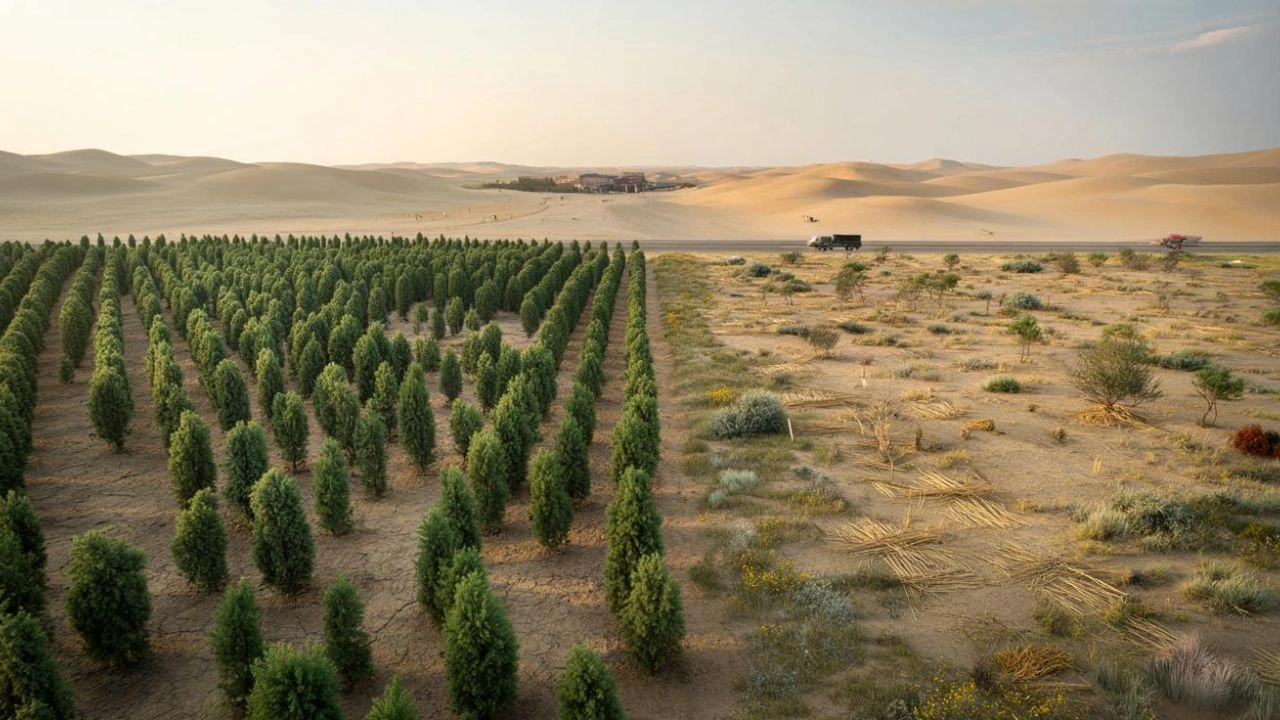
The China tree planting project has become one of the world’s most talked-about environmental efforts, and for good reason. Since the late 1970s, China has planted billions of trees in hopes of pushing back the rapidly expanding deserts that threaten farmlands, cities, and communities. From satellite images, it seems like a success story. Areas that were once dry and lifeless now appear green and thriving. But that is only part of the picture.
While the China tree planting project has helped reduce sandstorms and reclaimed some degraded land, experts on the ground are starting to sound the alarm. The issue is not the idea of planting trees but how and where they are being planted. In this article, we are going to explore how this massive campaign took shape, what it has actually accomplished, and why many scientists now believe it could be doing quiet damage to delicate ecosystems in ways that are hard to spot from space.
The China Tree Planting Project: A Green Mission with Mixed Results
At its core, the China tree planting project was designed to battle desertification, a serious issue that affects millions of people. In regions like Inner Mongolia and the southern edge of the Gobi Desert, desert sands were creeping into farmland and cities at an alarming pace. So, the government launched a bold plan: plant billions of trees to create a “Green Great Wall” that would stop the spread of desert sands. It was an ambitious and expensive plan, and on the surface, it worked. The number of dust storms has decreased, and satellite imagery shows greener landscapes where once there was only dust.
But those green patches are not always signs of healthy ecosystems. Many of the planted forests use non-native, fast-growing trees like poplar and pine. These trees grow quickly, but they also drink up large amounts of groundwater—often more than the land can support. In areas where these trees have been planted, water tables are dropping, native grasses are dying out, and soil health is suffering. What looks green from a distance may actually be drying out below the surface, leading scientists to question whether this method of reforestation is truly sustainable.
Overview Table: China Tree Planting Project at a Glance
| Key Aspect | Details |
| Project Launch | Late 1970s |
| Main Objective | Reclaim land and fight desertification |
| Number of Trees Planted | Over 70 billion trees |
| Primary Locations | Inner Mongolia, Ningxia, Gansu, edge of Gobi Desert |
| Common Species Used | Poplar, Pine, Sea Buckthorn |
| Reported Benefits | Fewer dust storms, greener satellite images |
| Main Environmental Concern | Excessive water use and soil degradation |
| Native Vegetation Impact | Loss of grasses and local plant life |
| Suggested Approach | Focus on native, drought-tolerant species |
| Long-Term Goal | Build healthy, water-efficient ecosystems |
A Green Wall That Changed the Desert’s Edge
When you walk through parts of Inner Mongolia today, you might notice something locals are quick to point out: the sand no longer blows in as fiercely as it used to. That is one of the visible benefits of the China tree planting project. In some villages, sand dunes that once crept closer every year have stopped advancing or even pulled back. This has helped protect farmlands, reduce storm-related damage, and improve daily life.
However, there is a catch. Many of these forests are made up of just one or two types of trees planted in tight, uniform rows. These trees may grow fast, but they do not offer the same support for biodiversity that native plant mixes do. They also tend to require more water, which can become a problem in areas that already receive very little rainfall. In time, many of these monoculture forests become weak and stressed, and in some cases, they even begin to die from the top down. This makes the land more fragile, not less.
Tree-Planting in Lands Made for Grass and Shrubs
One of the biggest misconceptions behind the China tree planting project is the idea that deserts are damaged environments that need to be fixed with trees. In truth, deserts are often well-balanced ecosystems filled with life—just not the tall, leafy kind that looks good from a distance. These regions naturally support drought-resistant grasses, bushes, and small trees that can survive long dry spells without human help.
By replacing these native systems with water-hungry tree plantations, the project can throw off the delicate balance of desert ecology. For example, in Minqin County, tree plantations seemed promising at first. But over time, the area saw its groundwater dry up, local wells run empty, and native vegetation disappear. The problem was not that trees were planted but that the wrong types of trees were planted in the wrong places. Now, scientists and local communities alike are calling for a shift in thinking.
The Quiet Damage Beneath Green Headlines
There is no question that the China tree planting project has delivered visible results. Green areas on maps and fewer dust storms in cities are wins that cannot be ignored. But those results have sometimes come at the cost of long-term sustainability. The forests created by the project often lack diversity, meaning they cannot support the full range of plants, animals, and insects that make an ecosystem strong.
Experts are now urging a change in approach. Rather than trying to cover drylands with uniform forests, future efforts should focus on planting a variety of native species that are already suited to the region’s natural water limits. These native plants help hold soil in place, protect groundwater, and support more resilient environments. It may not look as impressive in pictures, but it works better over time.
Two Key Concerns with the China Tree Planting Project
Monoculture Plantations
Many of the forests created under this project are monocultures, which means they are made up of just one or two tree types. These types of forests are more likely to suffer from disease, pest outbreaks, and drought. They also offer little support for wildlife and native plant life.
Groundwater Overuse
Fast-growing species like poplar need a lot of water. In dry areas, this can lead to a serious drop in groundwater levels, affecting both people and plants. Over time, this water stress makes the land less productive and harder to restore naturally.
Smarter Alternatives: What the Land Needs
Environmental scientists across China are now proposing a smarter solution. Instead of planting as many trees as possible, the focus should shift to planting the right trees—and in the right places. Drylands do better with low-growing, water-efficient plants like native grasses, shrubs, and scattered trees that are already adapted to the environment.
This type of reforestation takes more time and does not always produce fast results. But it is far more sustainable. These native plants help keep soil in place, reduce erosion, and create habitats for local wildlife. In the long run, restoring native vegetation may provide better results than forcing dense tree plantations into places where they were never meant to grow.
FAQs
Is the China tree planting project successful overall?
It has made progress in reducing desert expansion and dust storms, but the method has caused problems with water usage and ecosystem balance.
Why are monoculture forests not ideal?
Forests made of one or two species are weaker, need more water, and do not support local biodiversity as well as mixed forests.
Can deserts naturally support trees?
Some deserts can support trees, but usually only specific, drought-tolerant species. Forcing dense forests in dry areas often fails.
What are the long-term risks of the project?
Water depletion, soil degradation, and the loss of native plants are major concerns if current planting methods continue.
What is the recommended future strategy?
Focus on using native plants and creating mixed vegetation that supports the natural ecosystem and uses less water.