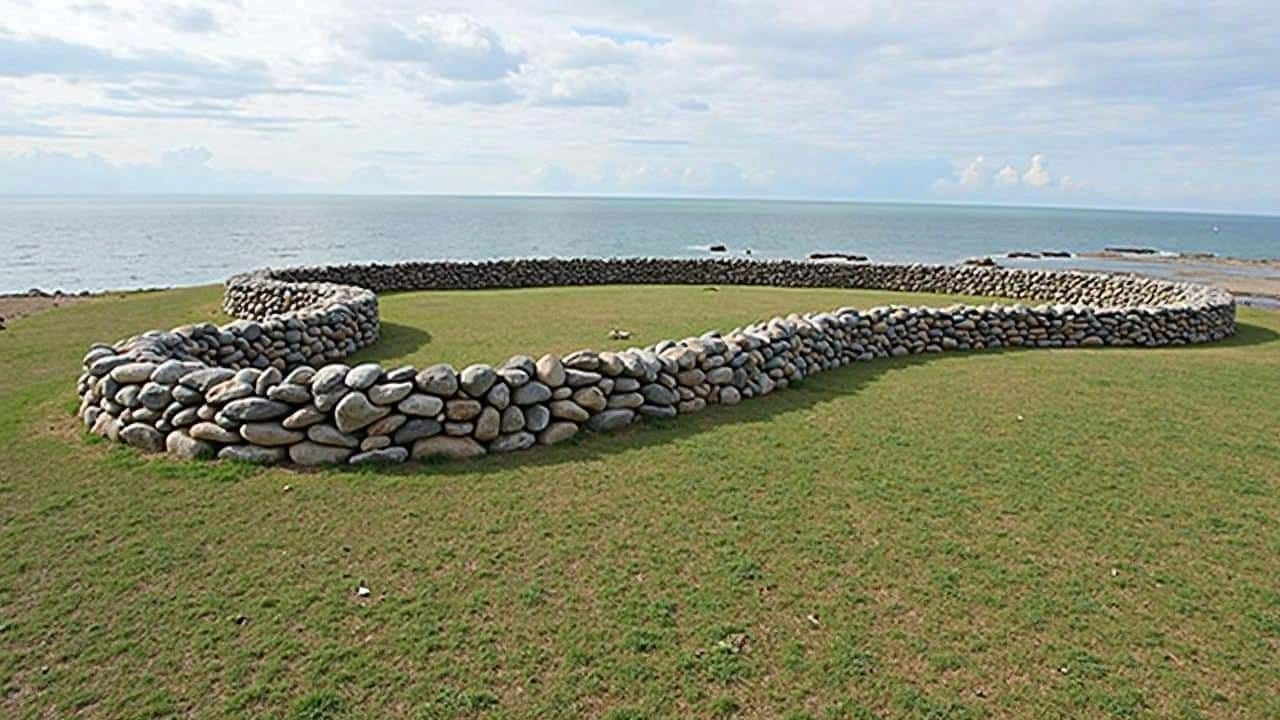
An ancient stone wall discovery off the coast of France is making archaeologists around the world rethink everything they thought they knew about early human societies. Buried under the waves near Brittany, this massive stone structure has sat silently for thousands of years, preserving secrets from a forgotten time.
The ancient stone wall discovery is more than just a curiosity—it is a monumental find that raises deep questions about who built it, why, and how. Researchers believe it could be around 7,000 years old and possibly created by hunter-gatherers. If true, it suggests that our early ancestors were far more advanced, organized, and inventive than previously assumed. In this article, we will explore the discovery itself, how it was found, its possible purpose, and why it matters today.
Ancient Stone Wall Discovery: A Closer Look
There is something truly powerful about finding a structure that has outlived entire civilizations. This ancient stone wall discovery is no exception. Located off the island of Sein in Brittany, France, the wall stretches over 120 meters long and stands up to two meters high. Its stones, some weighing hundreds of kilograms, are tightly packed together in a way that clearly shows human planning. Experts believe it was constructed sometime between 5800 and 5300 BC—before farming even reached this part of Europe.
What makes this even more incredible is the fact that it was likely built by Mesolithic hunter-gatherers. For a long time, people assumed these communities were constantly moving and lacked the stability or knowledge to build large, complex structures. But this wall flips that idea on its head. It suggests that these people were not just surviving—they were engineering their environment with purpose and long-term thinking.
Overview Table
| Key Information | Description |
| Location | Off Sein Island, Brittany, France |
| Depth Underwater | Approximately 9 meters below sea level |
| Structure Type | Stone wall with human-made features |
| Estimated Age | Between 5800 and 5300 BC |
| Builders | Mesolithic hunter-gatherer communities |
| Length of Structure | About 120 meters long |
| Height and Width | Up to 2 meters high and 20 meters wide |
| Material Used | Large granite blocks |
| Discovery Method | Sonar imaging, diver inspection, 3D mapping |
| Possible Purpose | Fish trap, coastal barrier, territorial marker |
A massive stone wall lying 9 metres under the sea
The first clue to this incredible find came from sonar scans taken by French geologist Yves Fouquet. While studying the ocean floor, he noticed a line that was far too straight to be natural. That strange reading turned out to be a wall made of massive granite blocks, resting nine meters beneath the sea’s surface.
At the time it was built, that area was not underwater. It was part of a broad coastal plain that slowly disappeared under rising sea levels as glaciers melted after the Ice Age. The people who lived there hunted, fished, and foraged along these shores. The fact that they built a structure of this scale—so large, so precise—suggests they were not just passing through. They had a connection to this place and the skills to build something that would last.
Hunter‑gatherers with a knack for major projects
When most people picture hunter-gatherers, they imagine small groups moving from place to place, leaving little behind. This ancient stone wall discovery forces us to rethink that idea. Constructing such a large and organized structure requires teamwork, planning, and leadership. It was not something built overnight.
The Mesolithic people who built this wall clearly had experience with stone construction. They would have needed tools, systems for moving heavy stones, and knowledge of how to position and stabilize them. The layout shows clear intention, not randomness. It points to a shared goal and an understanding of how to make something that would stand the test of time—and the sea.
What was the wall for?
The true purpose of the wall remains a mystery, but there are a few leading theories based on its shape and location. One strong possibility is that it served as a fish trap. The wall may have helped guide fish into shallow areas during low tide, making them easier to catch. Similar fish traps have been found in other ancient cultures.
Another theory is that the wall was built to act as a barrier against rising tides or waves, protecting inland areas or creating calm water zones. Some researchers also believe it might have been a territorial marker, used to show control over a specific area of coastline or fishing ground.
No matter which theory is correct, one thing is clear: this ancient stone wall discovery represents a level of thinking that goes beyond survival. It shows awareness of the environment and a desire to adapt it to meet the needs of the community.
A landscape swallowed by the Atlantic
Thousands of years ago, the coastline around Brittany looked very different. The sea was lower, and the land extended much farther than it does today. There were likely wetlands, dunes, and shallow bays teeming with fish and wildlife. This made it a prime area for seasonal settlements.
As global temperatures rose and glaciers melted, the ocean gradually moved inland, covering these once-livable areas. Over time, wooden tools, shelters, and other organic remains decayed, leaving behind only stone. That is why finds like this wall are so valuable. They give us a rare look into a world that was lost to the sea.
How underwater archaeology rewrites prehistory
Until recently, most archaeological work focused on dry land. Underwater exploration was too difficult and expensive. But with modern sonar, diving equipment, and 3D modeling, researchers can now explore submerged landscapes with incredible detail.
The discovery of this ancient stone wall shows just how much we have yet to learn. From sonar scans to sediment analysis, each piece of data helped confirm that this was no ordinary rock formation. It was a carefully built wall with purpose. As underwater archaeology advances, we will likely uncover more examples of early human ingenuity hidden beneath the waves.
From sonar blip to prehistoric monument
This wall’s journey from sonar scan to major discovery involved several careful steps:
- High-resolution sonar revealed a straight, unnatural shape underwater.
- Divers explored the site and confirmed human-made construction.
- Photographs and videos were used to build a 3D digital model of the wall.
- Sea-level data and sediment samples helped estimate its age and context.
Each of these stages confirmed that the ancient stone wall discovery was not just a lucky find. It was the result of collaboration between geology, archaeology, and ocean science—all coming together to uncover an extraordinary piece of the past.
Why this matters in an age of rising seas
Sea levels are rising again today, just as they did thousands of years ago. While we have satellites and computer models, early humans had only their observations and instincts. Still, they adapted. They studied their environment, built structures, and found ways to live with the changing coastline.
This ancient stone wall discovery is more than just a monument—it is a message. It tells us that humans have always faced climate challenges and found ways to respond. It reminds us that we are not the first to experience rising waters, and we can learn a lot from those who came before us.
FAQs
How old is the ancient stone wall discovery in France?
It is estimated to be between 7,000 and 7,500 years old, dating from around 5800 to 5300 BC.
Who built the underwater stone wall?
The structure was likely built by Mesolithic hunter-gatherer communities living along the coast of Brittany.
What methods were used to find and study the wall?
Researchers used sonar imaging, underwater dives, 3D reconstruction, and sediment analysis to confirm and date the structure.
What could the wall have been used for?
The wall may have served as a fish trap, shoreline barrier, or territorial marker, based on its location and construction.
Is this the only structure of its kind?
No, but it is one of the best-preserved and most clearly human-made examples of early coastal engineering in Europe.